What exactly is Job Hopping?
"Job Hopping" is defined as ~ changing “jobs frequently, especially as a means of quick financial gain or career advancement” (Source1).For some, this can mean changing jobs every couple of years. For others, it may be a string of even shorter-term jobs.
But either way, Job Hopping has long been looked at as a big “red flag” to hiring managers and employers.
So, why do people"hop" jobs?
Some simply crave change. These people have a hard time staying in any one place for any length of time. To them, commitment is a foreign concept. Understandably, employers are often wary of spending their time and money on these types of Job Hoppers. It is expensive to screen, train, and get any new employee up to speed. And if someone has a history of Job Hopping, employers are hesitant in making the investment with very little hope of a good return.
However, there are others who Job Hop for the right reasons. These people are confident in what they have to offer. They see each new job as a challenge and a way to use their talents to help them and their employer succeed.
For these Job Hoppers, each move is a step forward. They embrace the chance to come in contact with different types of businesses and people. They see changing companies as an opportunity to learn exactly the type of job they want and where they will make the best fit.
Luckily, there is a new crop of employers who can see the difference.
These savvy employers recognize that not all job hoppers are fickle or move on as a way to alleviate boredom. Instead, they see these Job Hoppers as positive additions to their workforce.
So which is it? Is Job Hopping, as some continue to believe, a sign of instability and a show of disloyalty? Or is it a potentially good thing if done for the right reasons?
It can be both. The key is being able to differentiate between the two.
To help, employers need to ask themselves these questions before eliminating a "job hopper":
- Does the candidate’s resume show an upward progression from job to job?
- Did they gain valuable experience and exposure through the move?
- Or do you see a disjointed or, even worse, backward list of jobs?
And while much of the questions about Job Hopping center around what the practice says about the employee, I think the real focus should be on what it says about the employer!
There is no doubt things have changed. Long gone are the days when it was the norm for employees to stay at the same company for 10, 15, or even 20 years or more ~ often counting on company pensions when they retired.
That kind of job longevity and stability is a thing of the past.
Is Job Hopping really a Reflection on the Employer, not the Employee? “Tweet This”
There is no doubt things have changed. Long gone are the days when it was the norm for employees to stay at the same company for 10, 15, or even 20 years or more ~ often counting on company pensions when they retired.
That kind of job longevity and stability is a thing of the past.
And who is to blame?
Is it the employees who expect “instant gratification” and are constantly in search of the next best thing?Or is it the employers who no longer show loyalty to their employees? Companies who don’t value those who work for them as partners in their success?
That is why the real question should be, what does the trend of Job Hopping really say about the current state of employment?
There is definitely less incentive for employees to stay with a company for any real length of time. Pensions are rarely offered. Even promotions are not always awarded to someone within a company’s current workforce.
Employees are simply not seeing any tangible rewards for being loyal.
Instead of staying put, leaving to explore what else is out there is seen as a more desirable option. And this absence of loyalty is even more apparent in some companies during trying times.
How can this trend to Job Hop change?
It needs to start with the Employer!
Creating a different kind of work environment that offers real incentives for good employees to stay is the key.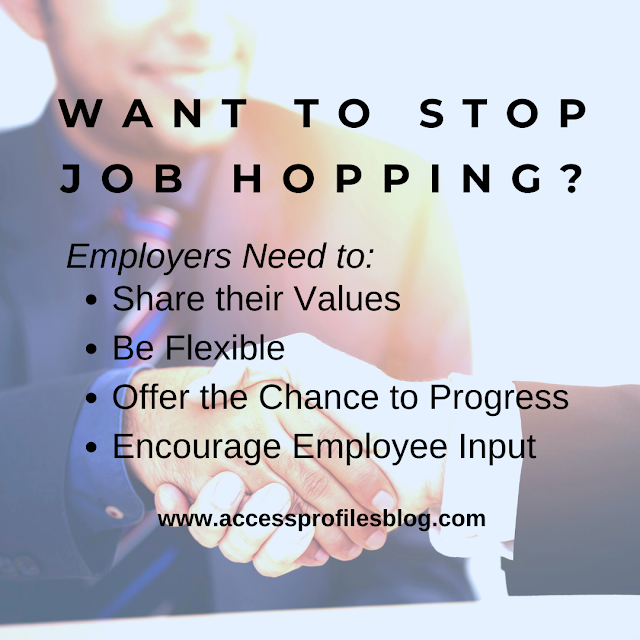
Employers Need to:
Share Their Values
Communicate Who You are and What You and Your Company stand for. Employees want to work at a company that matches their own values. That is why the more open and honest you are about what truly “speaks” to you, the more you will attract and retain employees who are on the same page.
This open communication should start during the hiring process so applicants know from the beginning whether they will be a good fit. It should then continue on a regular basis to keep your values reinforced with your existing employees.
Be Flexible
Offering your employees perks like flexible hours and the opportunity to telework makes your company a more attractive and desirable place to work. Especially during the current pandemic, offering the option to work from home, whenever possible, is key!
This is especially important to younger workers. It speaks to the demands that family life may place on them and gives them the chance to create a schedule that helps them meet those demands.
Offer the Opportunity to Progress
Establishing a strong “promote from within” policy whenever possible shows your commitment to helping your employees succeed. Providing your employees with the chance to achieve their career goals gives them a strong reason to stay.
Encourage Employee Input
By nature, people like to feel important, appreciated, and heard. Listening to your employees’ ideas and concerns is a start. Then it is even more import that you act on them. Feeling like part of a team will help generate the employee loyalty you need.
For more tips on attracting and keeping quality employees, read
"4 Reasons Why Job Seekers will Want to Work for Your Small Business" and “Tips to Help You Hire and Keep the Right Employees Part 2”!
Being willing to do everything you can to move beyond the perception that companies don’t care about their employees can make all the difference. Show your own loyalty and you will be sure to get loyalty back!
Before you know it, Job Hopping among the best employees will be a thing of the past!
Authored by

Contact Us! We can help you with your Hiring,
Business Mentoring, and Security Needs!

Be sure to Find out more About Us too!
Source 1: The Free Dictionary