 |
| Created by Kimberly Kline, API |
Harassment in the workplace is real.
All you have to do is take a look at the news,
or even your own workplace,
to know that it happens.
Instances can be subtle or blatant, emotional and physical. They can include the more obvious cases of sexual harassment, but even cover the use of offensive and hostile words or actions.
It is important to understand that workplace harassment is considered a form of discrimination under Title VII of the Civil Rights Act of 1964. Any inappropriate actions or words based on a person’s sex, age, race, disability, religion, or national origin are categorized as bias against a protected class.
And while the Equal Employment Opportunity Commission (EEOC) has weighed in on the matter before, workplace harassment is once again in their investigative crosshairs.
Their focus is on both eliminating it in the workplace and on identifying an employer’s obligations when it comes to dealing with it.
With these ends in mind, the EEOC has issued new recommendations under their “It’s On Us” campaign. The campaign is designed to bring greater attention to the dangers and prevalence of all types of harassment in the workplace.
“It’s On Us” to Stop Workplace Harassment! “Tweet This”
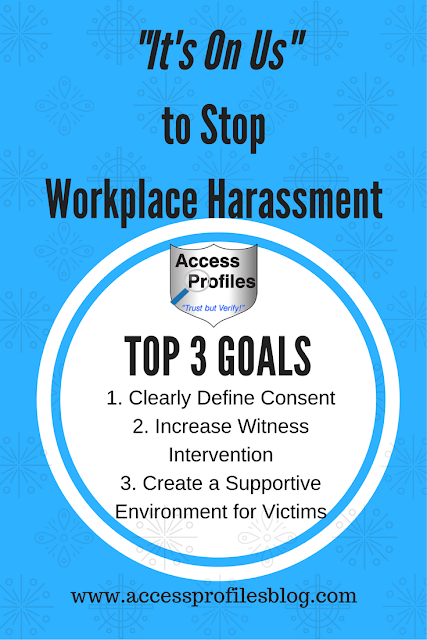
The “It’s On Us” Campaign has
3 Major Goals:
Clearly Define Consent
Increase Witness Intervention
Create a Supportive Environment for Victims
While certainly any company can be plagued by instances of workplace harassment, some factors can place your company at increased risk.
 |
| Created by Kimberly Kline, API |
4 Risk factors that Increase
Your Company’s Susceptibility to
Workplace Harassment
- Isolated Work Areas or Absence of Management
- A Lack of Diversity
- A Tolerant Workplace
- Favored Employees
The Bottom Line ~
It is in your company’s best interest
to stop workplace harassment.
Not only can it effect your company financially, but it can also damage your reputation.
Legal fees, judgments, loss of productivity, and higher turnover will place a hit on your finances. This can especially impact Small Businesses.
But the biggest hit will be on your company brand. Even allegations that you turned a blind eye or were slow to act in stopping harassment in your workplace can have ramifications. Your reputation and ability to attract and retain quality talent are at stake.
Responsibility for making changes in how your company deals with harassment needs to start at the top ~ with you, the business owner, and your managers and supervisors.
You need to develop a “follow the leader” mentality and set an example. When upper level employees are allowed to discriminate or harass, your company is in trouble.
It then continues with the creation and implementation of strong anti-harassment policies. The first step should include screening all your employees before you hire, and re-screening them before you promote. This sets the tone that you take workplace safety seriously.
In addition, your policies must outline acceptable workplace behavior and include your dedication to making your office a “zero tolerance” zone. They also must list your strategies for training and teaching the dangers of harassment and highlight how to report any instances of harassment.
But perhaps the most important thing of all is the prompt discipline of identified harassers. Your employees need to know you mean business.
It is crucial that you keep open the channels of communication between you, your management, and your employees concerning your policies and any employee concerns.
You can find out more about creating strong workplace harassment policies in “Dangers to Your Small Business - Workplace Bullies”.
The EEOC has place increased emphasis on keeping your employees aware of and knowledgeable about your workplace harassment policies. Simply having a policy in place is not enough.
Your policy must be given to all your employees and include a signed statement of receipt. Any updates you make must also be distributed.
Managers and employees must also be trained on how to safely report any incidents of alleged harassment. In addition, they also must understand the procedures concerning the investigation into the complaint. Your policy needs to emphasize that a prompt and thorough investigation will be conducted on any harassment allegations.
And this is not a “one and done”. This training must be ongoing to ensure everyone knows exactly how to proceed if a problem occurs.
It is also important for you to annually review your harassment policies. Make sure they comply with all new and existing laws and revamp any areas that need attention.
I leave you with one final suggestion ~ be absolutely sure to use background checks before you hire.
Not only will it help protect your small business from hiring unsafe or unskilled employees, it will also help weed out anyone with a past history of or tendency towards workplace harassment.
Periodically re-screening your existing employees is just as important. This is especially true if an employee is eligible for promotion. Being in a management position means having a certain amount of power over the employees they supervise. This is potentially when harassment can occur.
Discover more about why background checks are vital to small business in “If You are not Doing Background Checks, You are Making the Biggest Mistake Your Small Business Can Make!” and “Why You Need to Re-Screen Your Employees”.
There is no doubt that the EEOC is taking stronger measures to stop workplace harassment. Their “It’s On Us” campaign clearly shows their dedication to making sure all companies create and implement strong anti-harassment policies.
And they are specifically focusing on your company’s obligations to define consent, promote safe intervention, and provide an environment that support victims.
The time is now for you to do the same
in your Small Business.
Being proactive now
can save your company from
having to operate blindly
if an incident of workplace harassment occurs. Having detailed procedures already in place
is good for you and your business!
API can help you create strong screening procedures to help protect your Business!
Authored by

For more information, visit our
About Us and our Hiring, Business Mentoring, and Security Consulting pages.
You can also find
some common Business questions and answers
on our FAQ page!

No comments:
Post a Comment
Thanks for visiting our website. Contact Us! We can answer your questions and offer you a consultation on how we can help You with your Hiring, Business, and Security Needs!
We also invite you to Subscribe. Just leave your email and you will get one new article each month with tips and information focused on You and Your Business!