
 |
| Created by Kimberly Kline |
Small Business and Safety should go
hand in hand.
As an employer, it is crucial and beneficial that you ensure a safe and productive work environment for all your employees. And that means that you and your employees need to operate under the mindset that All Accidents and Workplace Safety Issues are Preventable.
Placing value in Workplace Safety is a culture that is communicated from leadership through the ranks. All levels of the company need to have the same goal and understand that goal.
Your dedication to safety begins by using background checks before you hire. It continues with your resolve to maintain a safe workplace through periodically re-screening your employees, employing workplace drug testing, and even addressing potential health issues like the COVID pandemic.
Click here to discover “Why You Need to Re-Screen Your Employees” and the importance of Workplace Drug Testing.
But one of the most successful tactics you can use to create a work environment that is as safe as possible is to make it a Team Effort. Getting all your employees onboard and creating the culture that safety is important makes sense.
And one of the most vital areas for you and your team to focus on should be the importance of Continued Behavior Observation.
Continued Behavior Observation is a method of identifying and reporting on any behavior that can create a problem in the workplace. When used consistently, you can increase productivity and reduce on the job accidents and injuries.
Your employees know each other better than anyone else. Creating an environment where each employee can easily observe and safely report when they see another employee exhibiting unusual or unsafe behavior is paramount. Employees also have to feel safe from repercussions or retaliation in doing so.
The most important benefit of Continued Behavior Observation is the ability to recognize and report any dangerous, erratic, or unusual employee behavior.
CBO is simply another tool in your workplace safety arsenal. And it can be applied to every aspect of your day to day operations.
It can improve the behavior of everyone from management and supervisors, to those responsible for your hands-on or on location based job duties. CBO not only makes your overall workplace safer, it will also increase your employees’ performance and competency. It is a great way to achieve your organizational goals and ensure your employees continually improve at their jobs.
To make Continued Behavior Observation work in your company, it is important that you first define exactly what target behavior you expect from your employees and understand the diversity of culture and individualism within your workforce.
The best way to do this is to first create a mission for your company. What do you want to achieve? What values do you want to emphasize? Knowing your core values and goals helps you identify exactly where you want your company to go.
You can find out more about identifying and using your own core values to find success in; “I Know Why I Do What I Do”!
Next, you should take a look at the job descriptions for each position in your company. Each job descriptions should clearly define the goals and objectives each employee hired in that position should achieve. From there you can determine what behavior will help each employee to get there.
These steps will help you discover what on-the-job behavior is necessary to keep your workplace safe and productive.

What Is Continued Behavior Observation & How Can You Use It in Your Small Business?
At its most basic, CBO uses your own employees, from management to entry level, to observe and correct unsafe workplace behavior and report to management any indication of aberrant behavior.
This can be informal, as in daily observation and reporting, or as part of a scheduled one-on-one period of observation.
In the more formal method, a designated employee will use simple techniques to observe another employee in their day to day job duties. The observer will then give feedback on ways to improve and eliminate any unsafe behavior.
In the informal example, an employee may witness another employee acting unsafely or even erratically. They can then simply make that employee aware of their observed behavior or, if necessary, report it to their supervisor or manager. It is then up to the supervisor to act on this information to keep the workplace safe.
The goal is to use the observer’s feedback to identify the unsafe behavior and make any changes necessary. At times the employee may be unaware they acting unsafely, and the feedback will help them recognize the problem. It can also encourage other employees to make an effort to continue working safely.
Some companies only use the informal method, possibly followed by the one-on-one observation if needed. Others rely on periodic formal observations. Either way, the result is to identify and decrease any instances of at risk behavior and increase safety across your workplace.
Your Company’s Safety Culture Needs to be a Team Effort! “Tweet This”
Making sure your company is dedicated to a continuing Safety Culture is good for your employees, customers, and your company bottom line.
Having a sound Company Safety Culture means that workplace safety is valued.
Each employee must feel a responsibility to keep their co-workers safe. In order to make this work, all employees must have the tools they need to not only observe and report unsafe behavior, but to feel supported and empowered by your company’s safety culture to act if they observe that safety being threatened. Each employee must be knowledgeable and trained in the best way to observe and report any unsafe behavior.
 |
| Created by Kimberly Kline |
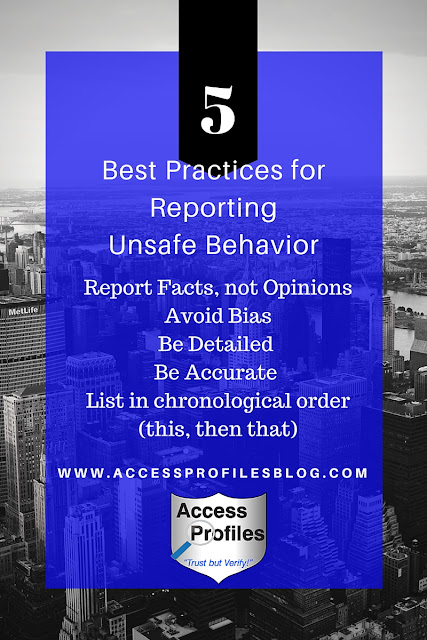
5 Best Practices for Reporting Unsafe Behavior
- Be sure to report facts, not opinions
- Be careful to avoid bias
- Be as detailed as possible
- Be sure to include only what you witness
- Be sure to explain the behavior in chronological order (this, then that)
Following these 5 steps will ensure any observations stick with the facts and are detailed enough to correct your employee’s unsafe behavior.
The key is to embrace Continued Behavior Observation as a vital tool in emphasizing safe and productive workplace practices, while recognizing and discouraging any unsafe ones. Everyone from management to employees must be on the same page and recognize the importance of having a safe workplace.
Make these Goals a Priority in Your Behavioral Observation Program:
Make Safety an Ongoing Conversation
Everyone needs to be vigilant and dedicated to a safe workplace. There must be open discussion between management, peers, and subordinates, about achieving safety goals and correcting unsafe behaviors. It must be as much about giving immediate praise for practicing safe behaviors as observing and offering solutions to correcting unsafe actions.
Make Safety Everyone’s Business
Don’t make it an “us versus them” mentality. It is not “ratting” on fellow employees, or having an agenda against anyone. It has to be about keeping everyone safe and making your company a great place to work. You and your employees must be in it together.
Reward Everyone for a Safe Workplace
While individual praise for safe behavior is essential, rewarding your entire company as a whole for a safe work environment is key. This fosters the idea that safety is a culture and driving force for your entire company. It also establishes a sense of pride in creating and maintaining a safe workplace. How you reward them is up to you, but making it inclusive of all should be your ultimate goal.
Workplace Safety needs to be a part of your company culture and it is vital that you get everyone involved. Not only will you have a safer and more productive company, but you will all be part of its success ~ as a TEAM!
Want to learn more about how You can have a Safe and Productive Workplace? Contact Us Now! API can guide you in the best practices to achieve your goal.
Authored by
Need Your Small Business Questions Answered?
Visit our Resources and FAQ page!
And be sure to check out our Hiring, Business Mentoring, and Security Consulting services too!

You will receive one new article each week dedicated to Business Tips and News! Thanks!

No comments:
Post a Comment
Thanks for visiting our website. Contact Us! We can answer your questions and offer you a consultation on how we can help You with your Hiring, Business, and Security Needs!
We also invite you to Subscribe. Just leave your email and you will get one new article each month with tips and information focused on You and Your Business!